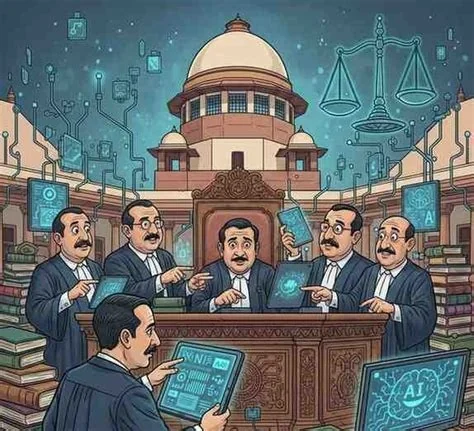
The Supreme Court of India has taken a firm stance against the use of AI-generated judgments in courts, warning that orders based on fake, AI-generated verdicts will be considered judicial misconduct. You should be aware that this move comes after a trial court was found to have relied on non-existent and fake judgments generated by artificial intelligence in its decision-making process.
Understanding the Supreme Court’s Decision
A bench of Justices PS Narasimha and Alok Aradhe stated that using AI-generated judgments will not just be seen as an error in decision-making but will amount to judicial misconduct, with real consequences. The court has issued a notice to the Attorney General, Solicitor General, and the Bar Council of India, and has appointed senior advocate Shyam Divan to assist in the matter.
The Case that Sparked this Decision
It all started with a property dispute case in Andhra Pradesh, where a trial court dismissed objections to a court-appointed commissioner’s report by citing four Supreme Court judgments that did not exist. When the defendants approached the Andhra Pradesh High Court, it acknowledged that the judgments were AI-generated, but merely issued a word of caution and affirmed the trial court’s decision on merits.
Implications for India’s Judiciary
By labeling the citation of fake case laws as misconduct rather than an error, the Supreme Court has significantly escalated the consequences. However, Indian law prescribes substantially different penalties for judges and lawyers. For judges, misconduct can trigger removal under Article 124(4) of the Constitution, but impeachment remains nearly impossible. You might wonder what this means for the future of AI in India’s judiciary.
Balancing Innovation and Accountability
As AI tools become increasingly prevalent in the legal profession, it’s clear that the Supreme Court is drawing a sharp line on their use in courts. But aren’t you concerned that being overly cautious might stifle innovation? Don’t AI tools have the potential to greatly benefit the legal profession, for example, by increasing efficiency and reducing costs?
Moving Forward
The Supreme Court’s move is a step in the right direction, but it’s only the beginning of a much-needed conversation. As the court continues to examine the matter, it’s essential for practitioners to be aware of the implications and take necessary precautions to avoid misconduct. Practitioners are advised to exercise caution when relying on AI-generated content in their work.
- The Supreme Court’s warning is a wake-up call for the legal profession.
- It’s essential for practitioners to understand the implications of this move.
- You must ensure that AI tools are used responsibly and in accordance with the law.
The conversation around AI in the judiciary is far from over, and it’s crucial that we strike a balance between harnessing the benefits of AI and ensuring that its use is transparent, accountable, and in line with the law.