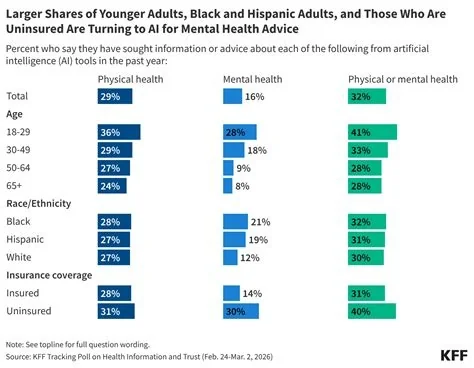
Thirty-two percent of U.S. adults now ask AI chatbots for health advice, matching social media usage rates. This surge reveals a healthcare system struggling with access and cost, forcing patients to seek immediate answers online instead of seeing a doctor.
Why People Choose AI Over Doctors
Most users didn’t stumble into this; they went there on purpose. About 65% of respondents cited a desire for “quick or immediate information” as a major reason for their search. The tech hype cycle usually focuses on generative AI writing code or generating art, but the real-world impact is happening in living rooms across the country.
It’s the cost of care, plain and simple. About one in five users said they turned to AI because they couldn’t afford a visit or couldn’t find an available appointment. If you’re making less than $40,000 a year, the likelihood of citing healthcare costs as a driver for using AI climbs to 32%.
Demographics Driving the Surge
Younger adults are eating this up. Adults under 30 are three times as likely as those over 50 to use AI for mental health information. The numbers are stark: 28% of the under-30 crowd compared to just 8% of older adults. And it’s not just age. Uninsured adults are twice as likely to rely on these tools as those with coverage (30% vs. 14%).
The Dangerous Follow-Through Gap
So, what happens when you get the answer? The follow-through is worrying. More than half (58%) of those who asked about mental health never saw a doctor afterward. Even for physical health issues, 42% didn’t follow up. These aren’t just casual queries; they are significant health decisions being made without professional oversight.
- Mental Health: 58% skip the doctor after AI consultation.
- Physical Issues: 42% fail to seek professional follow-up.
- Decision Making: 41% use AI info before deciding whether to see a provider.
When the decision to skip the doctor is driven by cost rather than clinical judgment, the line blurs. You might think you’re being responsible, but are you really?
Privacy Risks and Data Dangers
And let’s talk about privacy. The same poll found that many users upload personal health information into these systems despite valid privacy concerns. We know AI firms are touting tools specifically for health queries. We know the data is being processed. But are we really sure where that sensitive data is going?
It’s a classic tech dilemma: the solution creates new problems. AI offers immediate access to information that was previously gated behind insurance walls or long wait times. For many, it’s a lifeline. For others, it’s a bandage on a bullet wound.
How Doctors Are Adapting
The implications are massive, especially for the medical community. Physicians are concerned that patients are using AI to “interpret complicated results without the assistance of a physician.” Imagine a patient coming in with a diagnosis pulled from a chatbot that missed a critical nuance. How do you explain that to them without sounding dismissive?
Practitioners are already seeing the effects firsthand. “Patients are walking in with printouts from chatbots,” one primary care physician noted. “Some are well-researched, but many are based on hallucinations or outdated guidelines.” She explained that she now spends the first five minutes of an appointment untangling what an AI told them.
“We’re not just diagnosing; we’re diagnosing the diagnosis,” she added. The technology isn’t going away. AI firms are doubling down on health tools, and the infrastructure is already there. The real question isn’t whether people will use it, but how the healthcare system will adapt when the majority of the population treats a chatbot as their first line of defense.
We’re standing on the edge of a new era in medicine. One where the stethoscope and the smartphone are inextricably linked. The only thing missing is a clear set of rules for the AI in the room.