
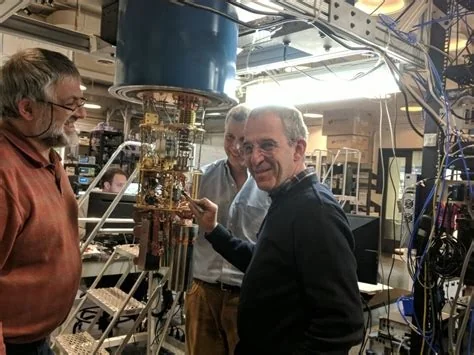
Nobel laureate Michel Devoret, a pioneer of superconducting qubits, says quantum computers are still far from practical use. He explains that while the physics behind qubits is solid, fragile quantum states and high error rates keep fault‑tolerant machines out of reach. If you’re counting on a near‑term breakthrough, his warning suggests you should temper expectations.
Why Quantum Hardware Still Struggles
The core issue is that quantum bits are exquisitely sensitive to any disturbance. Even a tiny interaction with the surrounding environment can cause decoherence, wiping out the information stored in a qubit. This inherent fragility means today’s processors are noisy and unreliable for large‑scale tasks.
Fragile Quantum States
Superconducting circuits can exhibit quantized energy levels, but those levels decay quickly unless the system is isolated perfectly. Researchers have extended coherence times, yet the gap between laboratory demonstrations and robust commercial devices remains wide.
Error‑Correction Thresholds
To build a fault‑tolerant machine, error rates must drop below a strict threshold—often quoted as less than one error in ten thousand operations. Current qubits still operate orders of magnitude above that level, so massive redundancy and sophisticated error‑correction codes are out of reach.
Implications for the Industry
Investors continue to pour capital into quantum startups, hoping for a breakthrough that unlocks a new market. However, the engineering hurdles highlighted by Devorte suggest that a fully error‑corrected quantum computer is likely many years away, not months.
Investment Reality Check
If you’re planning to allocate funds based on near‑term returns, you should reconsider. The timeline for a commercially viable quantum processor stretches well beyond the next few years, and many companies may need to adjust their business models.
Hybrid Computing Strategies
One pragmatic path is to treat quantum processors as specialized co‑processors. In this model, quantum chips handle narrow sub‑tasks—such as optimization or simulation—while classical hardware manages the bulk of the workload. This approach leverages current strengths without demanding full fault tolerance.
Expert Perspective
Dr. Lena Ortiz, a postdoctoral researcher at the Quantum Information Lab, sees Devorte’s caution as a healthy reality check. “We’re making steady progress on qubit coherence times and gate fidelities,” she says, “but the scaling problem is exponential. Even if we double the number of qubits each year, without robust error correction we’ll never cross the threshold for practical algorithms.” Ortiz’s team is exploring surface‑code architectures, which promise the most efficient path to fault tolerance—provided the hardware can meet the stringent error‑rate requirements.
Key Challenges to Watch
- Decoherence: Quantum states lose information quickly when exposed to noise.
- Error rates: Current qubits exceed the error‑correction threshold by orders of magnitude.
- Scalability: Adding more qubits amplifies noise and control complexity.
- Economic viability: Commercial applications remain limited until fault tolerance is achieved.
So, are you prepared to fund a technology that may need a decade or more before delivering real‑world value? The answer you choose will shape the next chapter of the quantum story.


