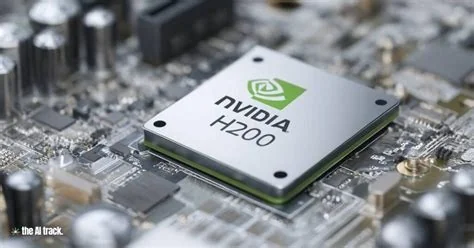
China has granted its first import clearance for Nvidia’s H200 AI accelerator, allowing several hundred thousand units to enter the market. The approval targets three leading Chinese internet companies and opens the door for additional firms to request access, marking a significant shift in the regulatory environment for high‑performance AI hardware.
Why China Approved Nvidia H200 Chips
Balancing AI Demand and Domestic Chip Goals
Chinese authorities aim to satisfy soaring domestic demand for cutting‑edge AI processors while continuing to develop a home‑grown semiconductor ecosystem. Approving the H200 provides immediate performance gains for AI workloads, yet the decision also reflects recognition that local alternatives have not yet reached comparable capability.
Key Features Driving Demand for the H200
Performance for Large Language Models
The H200 delivers exceptional compute density, enabling faster training and inference for large‑scale language models and generative‑AI applications. Its architecture accelerates matrix operations, reducing latency and power consumption compared with previous generations.
Targeted Industries in China
Beyond cloud services, the chip is sought after by finance, manufacturing, and autonomous‑driving sectors that require high‑throughput AI acceleration. Companies plan to embed the H200 in data‑center clusters to enhance recommendation engines, real‑time analytics, and next‑generation consumer products.
Regulatory Landscape and Export Controls
U.S. Licensing Requirements
The United States maintains strict export‑control rules for AI chips that exceed specific performance thresholds. Nvidia secured a U.S. license for the H200, allowing the hardware to be shipped abroad pending approval from the destination country.
China’s Semiconductor Strategy
China’s long‑term plan emphasizes reducing reliance on foreign technology through domestic design and fabrication. While substantial progress has been made, the nation’s current manufacturing capacity cannot yet produce chips with the H200’s performance level, prompting selective import approvals.
Impact on Chinese Cloud and Internet Services
Immediate Integration by Major Internet Firms
The first batch of H200 chips will be integrated into the data‑center infrastructure of three unnamed internet giants. This integration is expected to accelerate the rollout of large language models and generative‑AI services for millions of users across the country.
Future Opportunities Across Sectors
Following the initial clearance, additional enterprises are queuing for case‑by‑case approvals. Anticipated extensions include finance, smart manufacturing, and autonomous‑driving research, all of which have expressed strong interest in high‑performance AI accelerators.
What Comes Next for Nvidia H200 in China
Case‑by‑Case Approval Process
Each subsequent import request will undergo detailed scrutiny to ensure compliance with both U.S. licensing conditions and Chinese regulatory standards. This approach allows authorities to balance strategic interests with commercial demand.
Potential Market Expansion
If the approval framework remains stable, Nvidia could see a broader presence of H200 chips across Chinese enterprises, driving further AI innovation while simultaneously encouraging domestic chip developers to accelerate their own high‑performance designs.