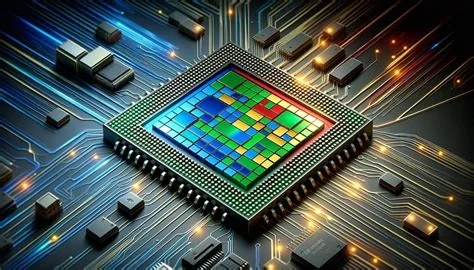
Microsoft’s new Maia 200 AI inference chip is now in production across Azure data centers, delivering up to 30% lower cost per inference compared to previous generation hardware. Built on a 3‑nm process with advanced FP8/FP4 tensor cores, the chip targets large language models and offers high throughput within a 750‑watt power envelope.
Key Features of the Maia 200 AI Chip
The Maia 200 combines native FP8/FP4 tensor cores with a high‑bandwidth memory subsystem to maximize inference efficiency.
Hardware Specifications
- Process technology: 3‑nanometer TSMC
- Transistor count: >140 billion
- Memory: 216 GB HBM3e, 7 TB/s bandwidth, 272 MB on‑die SRAM
- Compute capacity: 10 petaFLOPS FP4, 5 petaFLOPS FP8
- Power envelope: 750 W TDP
Performance Highlights
- FP4 performance up to three times that of previous‑generation inference accelerators
- FP8 performance surpasses leading competing TPU designs
- Dedicated data‑movement engines reduce memory bottlenecks for massive models
Azure Integration and Software Support
Maia 200 is deployed in Azure’s US Central region with expansion plans for additional locations. Developers can access the Maia SDK, which includes:
- PyTorch integration
- Triton compiler support
- Optimized kernel library
- Low‑level programming language for fine‑grained control
The SDK enables seamless migration of existing GPU‑based inference pipelines to the new accelerator.
Impact on Azure AI Services
By delivering higher throughput at lower power, Maia 200 reduces operational costs for Azure AI workloads. This cost advantage can be passed to enterprise customers running inference tasks such as Copilot, synthetic data generation, and reinforcement‑learning pipelines.
Future Outlook
Microsoft’s rollout of Maia 200 signals a shift toward vertically integrated AI infrastructure. As the chip expands to more regions, its promised cost savings and performance gains will be validated at scale, potentially setting a new benchmark for inference efficiency in the cloud.