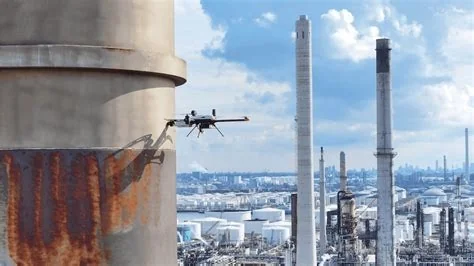
AI‑powered drones are transforming non‑destructive infrastructure inspection by combining autonomous flight, on‑board AI inference, and advanced sensor suites. These systems replace manual, labor‑intensive surveys with continuous, real‑time monitoring, delivering faster defect detection, enhanced safety, and lower operating costs. The technology is driving the inspection market toward a projected $102 billion valuation.
From Photo Ops to Continuous Monitoring
Modern inspection drones have evolved from simple aerial photography tools into continuous monitoring nodes. They stream live analytics to cloud‑based asset‑management platforms, enabling real‑time classification of corrosion, structural deformation, and other defects without human intervention.
AI Integration Boosts Speed, Safety, and Accuracy
Integrating AI with unmanned aerial vehicles accelerates data capture and analysis, allowing inspections to be performed faster, safer, and with higher precision. On‑board inference eliminates the need for personnel to climb towers or enter confined spaces, while AI models detect micro‑cracks and other anomalies that traditional visual checks often miss.
Hardware Advances Enable Real‑Time Edge AI
Purpose‑built drone platforms now feature edge processors capable of running deep‑learning models locally. This on‑board AI reduces latency, detects anomalies such as rust, loose bolts, and insulation defects in real time, and can automatically adjust flight paths to capture additional perspectives or initiate follow‑up missions.
Market Momentum Across Industries
Demand for AI‑driven inspection solutions is expanding rapidly across sectors. Telecommunications and data‑center operators leverage continuous monitoring to safeguard roofs, fiber‑optic networks, and cellular towers. Manufacturers adopt autonomous drones for fast, repeatable, non‑destructive testing of production lines, storage silos, and heavy equipment, achieving significant reductions in downtime and labor costs.
Implications for the Inspection Value Chain
- Data‑Centric Workflows – Real‑time AI inference creates actionable insights at the point of capture, enabling immediate repair prioritization.
- Regulatory Compliance Automation – Continuous monitoring logs inspection events, sensor readings, and AI‑generated defect reports, simplifying compliance reporting.
- Cost Structure Shift – Reducing reliance on specialized climb‑teams and manual data processing frees resources for predictive analytics and asset optimization.
- Scalability – Autonomous decision systems allow fleets of drones to operate concurrently across geographically dispersed assets, essential for utilities managing extensive transmission lines or pipelines.
Challenges and Outlook
Key challenges include maintaining AI performance under variable lighting and weather conditions, integrating heterogeneous sensor data into unified analytics, and navigating diverse UAV regulatory frameworks. Despite these hurdles, the convergence of AI, advanced sensors, and autonomous flight continues to deliver measurable gains in safety, speed, and inspection fidelity, positioning the market for sustained growth toward the projected $102 billion valuation.