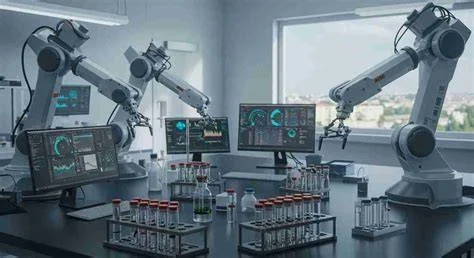
Self-driving labs are rapidly evolving from concept to reality, fundamentally reshaping scientific research. AI agents and robotic arms now plan, execute, and learn from experiments independently, slashing experimental cycles. This isn’t just an efficiency upgrade; it’s a complete overhaul of how breakthroughs happen. You’re witnessing a shift where human scientists move from manual tasks to strategic design.
Why Valuations Soar for Autonomous Labs
The buzz around startups like Periodic Labs highlights a massive market shift. Reports suggest these companies are securing billions in funding to build “AI scientists” that work alongside autonomous robots. Investors recognize that the promise of speed is worth every penny. In pharmaceuticals, where development timelines drag on for years, cutting cycle times dramatically can mean the difference between a life-saving treatment and a missed opportunity.
From Mechanics to Scientific Architects
The narrative isn’t about replacement; it’s about redefinition. As AI handles the technical grind, your role evolves into something far more conceptual. You become a “scientific tastemaker,” orchestrating the broader direction while machines handle the heavy lifting.
Gone are the days of spending weeks setting up assays or manually logging data. Modern facilities feature liquid handlers, plate washers, and robotic arms working in perfect sync. Instruments stream data directly into management systems, ensuring seamless integration. The conversation has moved from “will AI take over?” to “how do we safely integrate these tools for maximum impact?”
Autonomy Levels: Where We Stand Today
The industry adopts a spectrum borrowed from the automotive world to measure progress:
- Level 0: No assistance; everything is manual.
- Level 2-3: AI handles execution, but humans stay in the loop for critical decisions.
- Level 5: Humans set the goal and receive the result with zero intervention.
Most current implementations hover between Levels 2 and 3. Companies like Telescope Innovations are already pushing boundaries by installing fully integrated autonomous labs globally. Their recent facility in South Korea proves this technology is moving from the bench to the production floor.
Transforming High-Throughput Screening
Beyond raw speed, self-driving labs revolutionize reproducibility. High-throughput screening (HTS) now scales effortlessly while manual intervention drops to near zero. This reduction in human error ensures higher accuracy and faster turnaround times for patients.
AI models recognize patterns, flag bad plates, and predict maintenance needs before equipment fails. They optimize reaction conditions in real-time loops that no human could match, creating safer, smarter operations. The result is an ecosystem where data standards and interoperability are just as critical as the hardware itself.
The New Practitioner Skill Set
For you on the bench, the shift is palpable. Routine tasks like pipetting 96-well plates or cleaning glassware are disappearing. Instead, your day now demands a new skill set: interpreting complex AI outputs, designing high-level experimental frameworks, and troubleshooting when algorithms hit a blind spot.
The machine isn’t the boss; it’s the most powerful tool in your arsenal. You become the architect, designing the structure while the robot builds the walls. The question isn’t whether this future is coming. The question is, are you ready to hand over the controls?