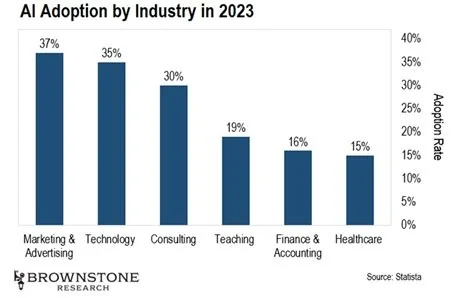
Artificial intelligence (AI) is transforming businesses, with major corporations rapidly adopting the technology to stay competitive. You’re likely wondering what’s driving this trend and how different industries are embracing AI. 78% of global companies now use AI in at least one business function, a significant increase that’s changing the business landscape.
Industry Leaders in AI Adoption
The IT and software sector is leading the charge, with many companies integrating AI into core operations like risk management and customer engagement. You might be surprised to know that healthcare and life sciences, financial services, and telecommunications are also among the top industries driving AI adoption. These sectors have made significant strides in AI implementation, with many companies using AI to support core business functions.
Industries Lagging Behind
However, not all industries are moving at the same pace. Construction, agriculture, education, and government services are lagging behind, due in part to limited data digitization, regulatory constraints, and a lack of skilled personnel. For instance, industries with structured, digitized data, such as tech and finance, can integrate AI more rapidly than sectors like construction or agriculture, where digitization may be limited. This doesn’t mean you can’t adopt AI, but you may need to take a more tailored approach.
Impact of AI Adoption on Businesses and Workers
As companies accelerate their AI adoption, many are also cutting jobs and shifting investments toward AI. You’re probably concerned about what this means for your business and your workforce. AI agents are rapidly becoming part of everyday operations, and organizations must prioritize AI agent governance to ensure successful implementation. The impact of AI on jobs is a pressing concern, but it’s also creating new opportunities for workers with the right skills.
Ensuring Successful AI Adoption
So, what can businesses do to ensure successful AI adoption? For starters, you must understand where your industry stands in terms of AI adoption and the forces shaping its adoption curve. This includes assessing data maturity, regulatory environments, and workforce skills. Companies must also focus on applying AI at the workflow level, rather than as isolated tools or short-term experiments. By taking a strategic approach, you can avoid costly pilots and achieve meaningful business outcomes.
Preparing for an AI-Driven Future
As AI continues to transform industries, it’s essential to understand the nuances of AI adoption in your industry. This includes identifying areas where AI can drive the most value, assessing data quality and availability, and developing a clear plan for implementation and governance. Are you ready to take the leap and position your company for success in an AI-driven world? By staying informed and adapting quickly, you can ensure your business stays ahead of the curve.
- Assess your industry’s AI adoption and the forces shaping its adoption curve.
- Develop a clear plan for implementation and governance.
- Focus on applying AI at the workflow level, rather than as isolated tools or short-term experiments.
By following these steps, you can ensure your company is well-positioned for success in an AI-driven world. The future of AI is here, and it’s up to you to harness its potential.