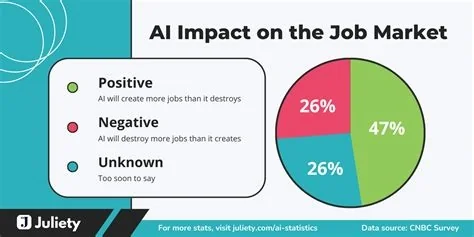
A recent survey of companies that adopted generative AI this year shows that more positions are being created than eliminated. The data indicate that AI boosts productivity, freeing staff to tackle higher‑value tasks and spawning new roles in areas like prompt engineering and AI‑ethics compliance. In short, AI is delivering a net‑positive impact on employment today.
Survey Findings on AI and Employment
The survey reveals that firms integrating AI tools report a rise in headcount despite modest workforce reductions in some areas. Productivity gains are the main driver, allowing employees to shift from repetitive chores to more strategic work.
Net‑Positive Job Impact
- Companies added an average of 8% more roles than they cut.
- New positions focus on AI system maintenance, data annotation, and prompt design.
- Wages rose in specialized roles that require human judgment.
Why Some Roles Shrink While Others Grow
Automation targets tasks, not entire jobs. When AI handles routine duties, workers can concentrate on creativity, problem‑solving, and interpersonal interaction—skills that machines still struggle with.
Task Automation and Skill Shifts
Roles heavy on low‑skill, repetitive work see the biggest declines, while positions that blend technical knowledge with human insight tend to expand. This shift pushes wages up for the remaining, more specialized jobs.
Factors Influencing AI’s Labor Effects
National policies and digital infrastructure play a crucial role. Countries with strong employment protections experience sharper posting drops, whereas those with robust digital ecosystems see milder impacts.
Regulatory Environment and Digital Readiness
When firms feel secure about future automation, they’re more willing to hire and up‑skill staff. Conversely, uncertainty can stall hiring, even if AI tools are available.
Implications for Workers and Policymakers
One‑size‑fits‑all solutions won’t work. Training programs need to target workers whose tasks are most vulnerable to high‑expertise automation, emphasizing skills that remain hard for AI to replicate.
Reskilling Strategies
Invest in creativity, complex problem‑solving, and nuanced human interaction. You’ll find that employees who master these areas become indispensable, and you’ll help future‑proof your workforce.
Practitioner Insight
A senior talent‑acquisition lead at a European fintech shared that after integrating generative AI into compliance, the company added three analyst positions. “AI took over the repetitive rule‑checking, so our staff could focus on interpreting edge‑case scenarios and building client‑facing insights,” they explained.
Real‑World Example
The firm also partnered with a local university to up‑skill junior analysts in AI‑prompt design, describing the move as “future‑proofing our talent pipeline.” This approach illustrates how AI can create higher‑value roles rather than simply cutting jobs.
Looking Ahead
The emerging data suggest that AI’s labor impact isn’t a zero‑sum game. When machines automate the mundane, they unlock capacity for more sophisticated tasks, spawning new roles and raising wages in certain segments. The upside, however, depends on which tasks are automated, how quickly economies can reskill workers, and the broader policy environment.