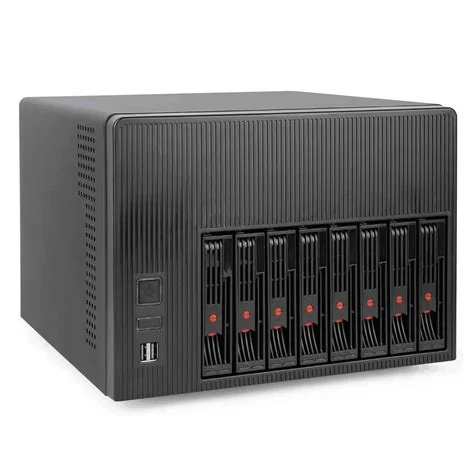
Network‑Attached Storage (NAS) is a dedicated device that connects to a local network, enabling multiple users and devices to store, share, and access files centrally. Modern NAS combines high‑speed Ethernet, scalable Linux‑based operating systems, and flexible hardware options, making it essential for home labs, small businesses, and enterprise environments seeking reliable, cost‑effective data management.
What Is NAS and Why It Matters Today
A NAS appliance provides shared storage over Ethernet or Wi‑Fi, replacing scattered external drives and slow cloud sync cycles. By centralising data, it offers flexible file access, robust backup capabilities, and built‑in services such as media streaming and virtualization. The device runs a lightweight Linux‑based OS that manages protocols like SMB, NFS, and AFP, delivering secure, scalable storage for any networked environment.
Enterprise‑Grade NAS Solutions
High‑Performance File Services for Large Organizations
Enterprise NAS platforms deliver high‑throughput file services, data reduction, and sustainability features that align with corporate ESG goals. They act as a bridge between traditional file‑share environments and cloud‑native applications, exposing APIs that let developers embed file‑level storage directly into modern workloads. These solutions prioritize reliability, redundancy, and integration with broader data‑management strategies.
DIY NAS for Advanced Home Builders
Cost‑Effective Mini‑ITX Builds with 10 GbE
The DIY community embraces mini‑ITX motherboards equipped with built‑in 10 GbE interfaces, offering enterprise‑class network speeds at a fraction of the cost. Boards such as the CWWK M8 support low‑power Intel processors and provide ample expansion for multiple drives, making them ideal for multi‑user media transcoding, light virtualization, and discreet rack‑mountable deployments.
Linux‑Based NAS Operating Systems
Replacing Proprietary Firmware with Open‑Source Flexibility
Power users increasingly swap vendor‑locked NAS firmware for mainstream Linux distributions. This transition delivers better performance, broader software compatibility, and the ability to run containers, snapshots, and custom services without restrictive dashboards. Open‑source NAS stacks empower administrators to tailor storage solutions to specific workloads while maintaining a familiar Linux environment.
Implications for the Storage Landscape
- Hybrid Adoption: Enterprises continue to deploy purpose‑built NAS for mission‑critical workloads while encouraging internal teams to experiment with DIY or Linux‑based solutions for testing and edge use cases.
- Performance Expectations: Affordable motherboards with 10 GbE raise the baseline speed for home and small‑office NAS, narrowing the gap with enterprise hardware and enabling high‑speed file sharing.
- Software Flexibility: Growing demand for open‑source OSes may push vendors to offer modular, Linux‑compatible firmware that balances turnkey simplicity with deep customization.
Practitioner Perspective
One experienced user reports that migrating from a proprietary NAS OS to Ubuntu resulted in faster file transfers, seamless Docker integration, and a more intuitive interface. This anecdote reflects a broader confidence among technically proficient users to manage storage with mainstream Linux tools rather than constrained vendor dashboards.
Conclusion
As data volumes surge and remote collaboration becomes standard, NAS remains a cornerstone technology. Whether delivered as a polished enterprise appliance, a DIY mini‑ITX build, or a flexible Linux workstation, modern NAS solutions are redefining networked storage with openness, high performance, and sustainability at the forefront.