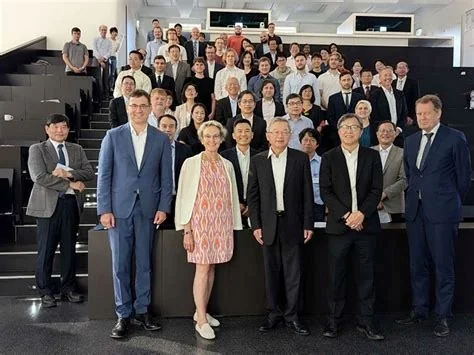
Taiwan and Germany are set to strengthen their collaboration on semiconductors and artificial intelligence (AI), a move that’s expected to further solidify Taiwan’s position as a leader in the global electronics supply chain. You can expect this partnership to drive innovation and growth in these critical areas, benefiting both nations and the global tech industry. Taiwan is already a key player, handling much of the semiconductor design, fabrication, packaging, and testing for major brands.
Strengthening Taiwan’s Semiconductor Industry
Taiwan’s domestic ecosystem can also supply parts such as capacitors and printed circuit boards, as well as complete servers for AI data centers. However, the industry is facing challenges, including a shortage of 34,000 workers in the semiconductor sector. To tackle this issue, the National Science and Technology Council (NSTC) is focusing on education and training programs for multidisciplinary technologists. As NSTC Minister Cheng-Wen Wu said, “Taiwan urgently requires multidisciplinary professionals who can simultaneously master hardware-software co-design, thermal management, and system-architecture planning.” You might wonder, what’s driving this growth? It’s no secret that AI is behind the surge in demand for semiconductors.
Germany’s Semiconductor Industry and Collaboration
Germany, for its part, is looking to strengthen its own semiconductor industry, and a collaboration with Taiwan could provide a significant boost. This partnership-driven expansion combines strengths from different nations to drive growth. The implications of this collaboration are significant. A stronger semiconductor and AI ecosystem in Taiwan and Germany could lead to breakthroughs in areas like edge computing, autonomous systems, and 6G technology.
Resilient and Diversified Global Supply Chain
It could also help to create a more resilient and diversified global supply chain, reducing reliance on any one nation or region. This is crucial, especially with concerns about potential Section 232 tariffs from the US government and geopolitical tensions with China. By working together, Taiwan and Germany can help Taiwanese electronics manufacturers navigate the complex global landscape.
Future Developments and Global Impact
With Taiwan and Germany leading the charge, you can expect to see exciting developments in the world of semiconductors and AI. President Lai of Taiwan recently emphasized the importance of deepening cooperation with the US and other democratic allied nations. The government’s Ten Major AI Infrastructure Projects initiative aims to train 500,000 professionals in AI-related fields. As the global electronics supply chain continues to evolve, it’s clear that Taiwan will remain a key player.
For tech industry professionals, this collaboration is a welcome development. It highlights the importance of international cooperation and knowledge-sharing in driving innovation and growth. But what does this mean for the future of AI and semiconductors? The intersection of technology and geopolitics will continue to shape the industry in the years to come. As you look to the future, one thing is certain: the stakes are high, and the competition is fierce.