Standard 12-lead ECGs are finally becoming powerful screens for heart failure. New AI models can now detect reduced Left Ventricular Ejection Fraction (LVEF) without expensive echocardiograms. This shift saves time and resources while catching critical issues earlier. You’ll soon see these tools in routine checkups, turning basic heart rhythm data into a vital diagnostic weapon. The era of expensive, delayed testing is ending.
Two-Stage AI Pipeline Delivers High Accuracy
Researchers in the UAE recently published a groundbreaking study on a “two-stage” machine learning approach. They avoided black-box algorithms in favor of an interpretable-first system designed for real-world clinical use. The team analyzed data from over 37,000 patients at Cleveland Clinic Abu Dhabi, yielding striking results.
Stage 1: Ruling Out Disease Quickly
The first stage uses a logistic regression model to screen for any reduced LVEF. It achieved an Area Under the Curve (AUC) of 0.82 in validation sets. More importantly, the Negative Predictive Value hit 91%. If the AI says your heart is fine, it’s right 91% of the time. For doctors, this massive relief allows them to focus scarce echocardiography resources on patients who actually need them.
Stage 2: Grading Severity Precisely
When the first stage flags a patient, an XGBoost classifier steps up to grade the dysfunction as mild, moderate, or severe. The model maintained a solid 72% overall accuracy in stratifying these levels. The team validated these findings on data spanning multiple years, proving the model holds up over time. This isn’t just a theoretical exercise; it’s a practical workflow solution.
Closing the Global Data Gap
Most existing AI tools for LVEF have been validated on Western populations. By testing this on a diverse Middle Eastern cohort, researchers filled a critical gap. It’s a reminder that algorithms trained in one demographic often stumble when applied to another. This study ensures the technology works for everyone, not just a specific group.
Mamba Architecture Beats Traditional Deep Learning
While the UAE study focused on workflow, another paper hints at a better way to process the data. Enter the “1DCNN-ECG-Mamba,” a hybrid model that combines a 1D CNN with the Mamba architecture.
Traditional deep learning models like Convolutional Neural Networks (CNNs) and Transformers have dominated the ECG space. But they struggle with long sequential signals found in 10-second 12-lead recordings. They get bogged down. The new Mamba adaptation, introduced by researchers including Huajun Jiang, aims to fix this.
- Mamba is a state space model designed for efficient sequence modeling.
- It handles temporal dependencies much better than its predecessors.
- The hybrid system outperformed existing methods in major challenges.
In tests against major competition datasets, the 1DCNN-ECG-Mamba achieved substantially higher AUPRC and AUROC scores across twelve-lead ECGs. Speed and accuracy are the lifeblood of cardiology, and this model delivers both.
Why Faster Screening Changes Everything
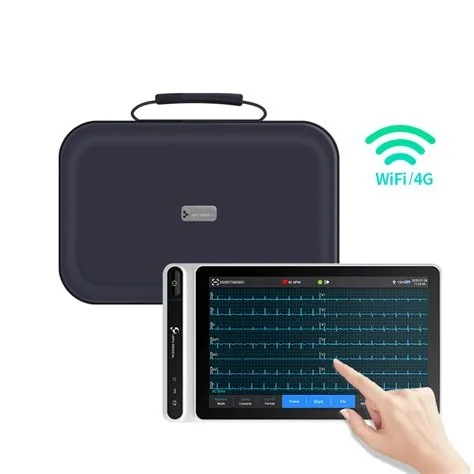
If a computer can flag a potential heart failure risk in seconds, treatment can start days sooner. We are seeing collaborations between major tech and health players accelerate the validation of these algorithms. Plus, the hardware is catching up. Pocket-sized 12-lead machines are hitting the market, making remote monitoring a reality.
Imagine a patient in a rural clinic grabbing a device, snapping a 12-lead ECG, and getting an immediate AI-driven risk assessment before they even leave the office. The ecosystem is moving fast, and you’re the beneficiary of this rapid innovation.
The Catch: Data Quality and Transparency
These models are only as good as the data they are fed. The UAE study emphasized that their model relied on de-identified data from a single quaternary-care center. While the temporal validation was robust, scaling this globally requires more diverse datasets.
Doctors need to trust the “why” behind the AI’s decision. The “interpretable-first” approach is crucial here. If the AI says “low LVEF,” the physician needs to understand which ECG features triggered that flag. Without that transparency, the tech remains a black box that is hard to prescribe.
The Future of Heart Health is Here
The future of ECG isn’t just about reading the lines on a graph anymore. It’s about reading the patterns the human eye misses, processed by models that are faster, deeper, and more inclusive. The technology is ready. The question is, are our healthcare systems ready to embrace it?
For busy cardiologists and primary care physicians, the immediate takeaway is about workflow triage. The high negative predictive value means you can safely rule out severe heart failure in a large chunk of patients without ever ordering an echo. The machines are listening. Now, we just have to make sure the humans are listening too.