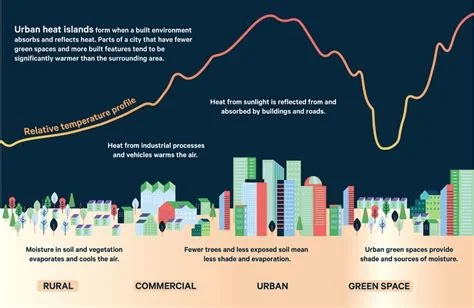
Running the digital revolution comes with a hidden cost: literal warming. While you might know ChatGPT or AI training strains the power grid, a new study highlights a less obvious consequence of these sprawling warehouses. Research suggests that the massive data centers powering the AI boom are acting like giant radiators, blasting their neighborhoods with heat and creating intense urban heat islands.
Cambridge Researchers Map 20 Years of Temperature Data
It’s a phenomenon scientists are studying closer than ever, and the results are starting to spark concern. Researchers at the University of Cambridge recently looked back at 20 years of temperature data, mapping it against the locations of massive data centers. They found that once these facilities start humming, the land around them gets significantly hotter.
9 Degrees Celsius Is Just the Average
Surface temperatures often rise by an average of 9 degrees Celsius. In extreme cases, the heat is even more intense. You’re talking about a jump comparable to the difference between a pleasant Delhi winter morning and a scorching May afternoon. That’s not just uncomfortable; it’s a dramatic shift in the local climate.
Global Pattern Spanning From Spain to Mexico
It’s not just happening in one place, either. The pattern holds true globally, from the Bajio region of Mexico, a hub for AI infrastructure, all the way to Aragon in Spain. Both areas recorded unexplained temperature rises of about 9 degrees—starkly different from their cooler, rural neighbors.
Why This Matters for Urban Planning
As the global demand for AI skyrockets, so does the number of these data centers. They are sprawling complexes covering over 93,000 square meters, filled with rows of servers, GPUs, and CPUs that never sleep. According to lead researcher Andrea Marinoni, the expansion of these facilities “could have dramatic impacts on society.” It’s not just about the environment; it’s about people’s welfare and the local economy.
How Artificial Heat Complicates the Urban Problem
The heat island effect is a known urban problem, usually caused by buildings, concrete, and asphalt absorbing heat while trees and grass do the cooling. Data centers are just adding a massive, artificial layer to that mix. The impact can stretch far beyond the facility’s fence. Temperatures were found rising up to 10 kilometers away—the distance from Connaught Place in Delhi to Noida’s Sector 18.
Future Tech Hubs Must Adapt Cooling Strategies
With cities like Mumbai, Chennai, and Hyderabad emerging as major tech hubs, the pressure on local infrastructure is only going to increase. For governments planning for the future, this isn’t just a theoretical problem; it’s a pressing local concern. If you keep building these digital fortresses without adjusting how we manage heat, you’re going to be living in a much warmer world.
Practitioners Perspective
From the ground floor, the reality is already clear. We’re seeing temperatures spike where these facilities go online, and it’s forcing designers to rethink cooling strategies. It’s no longer just about keeping the servers happy—it’s about keeping the neighborhood livable for everyone.