
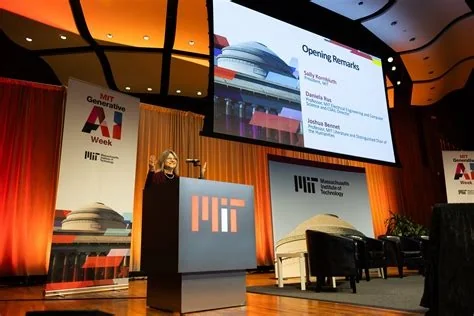
MIT President L. Rodney Miller used a live public‑radio interview to explain why bold AI research matters for everyday listeners. He highlighted how artificial‑intelligence breakthroughs are reshaping sports, health and public policy, and he urged you to watch these developments as they move from labs to the airwaves. The segment shows AI’s real‑world impact in plain language.
AI Enhances Athletic Performance at MIT Sports Lab
Deep‑Learning Models Predict Figure‑Skating Jumps
Researchers at MIT’s Sports Lab have trained deep‑learning models on motion‑capture data to forecast the feasibility of five‑rotation jumps. These predictions arrive faster than any human coach can analyze, giving athletes a clear view of biomechanical limits. The team believes the tools will help skaters fine‑tune technique while keeping the human element central.
Football Analytics Gets Smarter
By applying AI to game footage, the lab is uncovering patterns that traditional stats miss. Coaches can now adjust strategies mid‑season based on real‑time insights, and fans get a richer understanding of the sport.
AI‑Driven Drug Discovery Targets Ovarian Cancer
MIT scientists are leveraging generative AI to design molecules that could halt ovarian‑cancer growth. Early simulations suggest several candidates merit laboratory testing, potentially shortening the path from concept to clinical trial. This approach illustrates how AI can accelerate life‑saving research.
Project AI Evidence Connects Technology to Poverty Alleviation
A new MIT initiative, Project AI Evidence, brings together governments, tech firms and nonprofit leaders to evaluate AI solutions aimed at reducing poverty. The program tests algorithms in real‑world settings, gathers rigorous data, and scales what works. By focusing on measurable outcomes, the project aims to turn hype into tangible impact.
Public Radio Experiments with AI Tools
Broadcasters are piloting AI‑generated transcripts and personalized playlists to improve listener experience. Yet editors remain in the loop, ensuring accuracy and preserving the trusted voice you rely on. These experiments show how AI can enhance, not replace, human judgment.
What This Means for You
- AI could help a skater land a flawless quadruple‑loop, and the same technology might flag misinformation in news stories you hear.
- Predictive models from Project AI Evidence may enable faster responses to food‑security crises in your community.
- Transparent AI practices at radio stations could strengthen the medium’s credibility, giving you more reliable information.
Practitioner Perspectives
Insights from MIT Sports Lab
Dr. Maya Khan explains, “The real breakthrough isn’t the algorithm itself, but the partnership between engineers, athletes and coaches.” She stresses that AI tools are designed to complement human expertise, echoing the mantra that technology should be a tool, not a voice.
Broadcaster Viewpoint
Veteran host Carlos Mendoza notes, “Having MIT’s president discuss AI on air gives our audience a concrete sense of why these technologies matter beyond the hype.” He plans to pilot AI‑assisted segments that pull in relevant research during live discussions while keeping a human editor to verify accuracy.


