
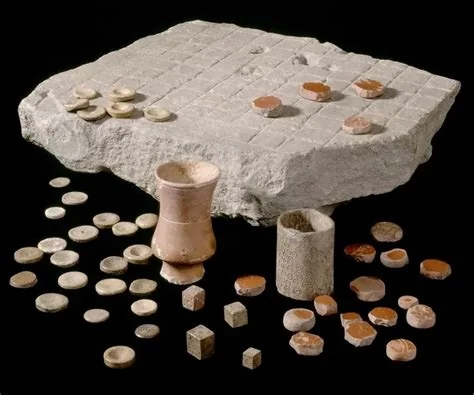
An AI platform called Ludii has finally decoded the rules of a 1,500‑year‑old Roman board game carved into a limestone slab from Heerlen. By matching simulated wear patterns to the stone’s ancient grooves, researchers uncovered a simple blocking game where two players slide pieces to avoid being trapped. This breakthrough shows how AI can turn mysterious scars into a playable blueprint.
How AI Turned a Stone into a Game Blueprint
The slab, long displayed as an enigmatic artifact, features shallow channels that look like the remnants of countless moves. Instead of guessing, the team fed the exact dimensions and wear marks into Ludii, letting the system explore thousands of possible rule sets. The AI then compared each simulated outcome with the real‑world scratches, narrowing the field until one set reproduced the observed pattern.
Feeding the Board to Ludii
Researchers first measured every groove, recorded the depth of each mark, and programmed Ludii to treat the stone as a virtual board. They let the AI try everything from three‑piece duels to four‑piece contests, letting each scenario run thousands of games in minutes. The process was pure brute‑force, but the constraints guided the AI toward plausible human play.
What the Winning Rule Set Looks Like
The AI’s top solution is elegantly simple: two players start with unequal fleets—one with four pieces, the other with two—and take turns sliding them along the carved channels. The goal is to keep moving; once a piece is blocked, it’s out of play. The player who can sustain motion the longest claims victory. This “blocking” mechanic mirrors many modern abstract games, proving that ancient Romans enjoyed strategic tension.
Why This AI‑Driven Discovery Matters
Beyond satisfying curiosity, the find demonstrates AI’s potential as an investigative partner for archaeology. Traditional game reconstruction leans on written records or surviving pieces, but many ancient games left only the wear on playing surfaces. By treating those marks as data, AI can infer rules without any textual clues.
From Game Scars to Playbook
Every groove on the limestone acts like a fingerprint of past moves. Ludii turned those fingerprints into a digital playbook, offering a concrete set of actions that explains why the stone looks the way it does. If you’ve ever wondered how a silent stone could speak, this method shows a clear pathway.
Boosting Archaeological Insight
With AI, archaeologists can now test hypotheses in hours instead of months. The platform lets scholars worldwide adjust parameters, propose alternative rules, and instantly see how the simulated wear stacks up against the real artifact. This democratizes the research process and speeds up the cycle from speculation to evidence‑backed theory.
Limitations and Future Directions
While the AI‑generated rules fit the observed wear, they rest on key assumptions: the marks must stem solely from gameplay, not from later handling or natural erosion. The model also assumes players followed consistent strategies, which may not reflect the full diversity of ancient play.
Assumptions Behind the Model
The current approach treats the stone as a closed system, ignoring possible post‑depositional damage. Future work will need to factor in wear from cleaning, transport, or environmental exposure. Until those variables are quantified, the proposed rules remain a strong hypothesis rather than definitive proof.
Next Steps for AI in Archaeology
Researchers are already eyeing other etched stones, game boards, and even ancient dice for similar AI analysis. As you explore the possibilities, consider that AI can help turn any ambiguous surface into a testable scenario, opening doors to countless forgotten pastimes. The marriage of ancient artifacts and modern computation promises to illuminate many more mysteries hidden in stone.


