
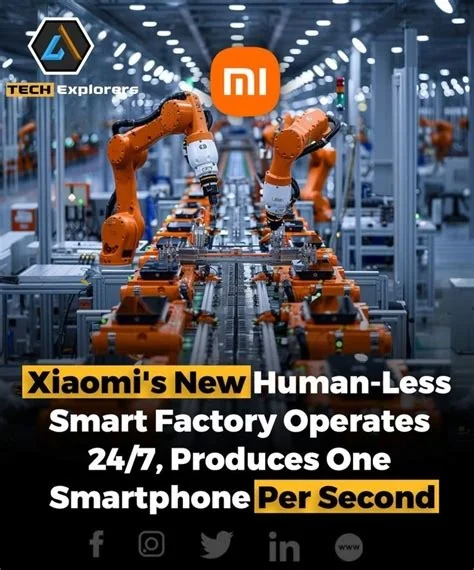
Xiaomi has opened an 81,000‑square‑metre fully automated “dark factory” in Beijing that can assemble a smartphone every second, delivering over 10 million devices annually. The plant runs without human workers, lighting, or climate control, relying on AI‑driven robotics, machine‑vision inspection and a centralized Hyper Intelligent Manufacturing Platform to maintain continuous, high‑quality production.
What Is a Dark Factory?
A dark factory is a manufacturing environment designed to operate without human presence on the shop floor. By eliminating the need for lighting and climate control, the facility can run 24/7, using robots, artificial intelligence and tightly integrated systems to keep production flowing uninterrupted.
AI‑Powered Manufacturing Platform
Hyper Intelligent Manufacturing Platform (HyperIMP)
HyperIMP serves as the brain of Xiaomi’s line. Unlike traditional programmable logic controllers, this distributed control system continuously analyzes data from thousands of sensors, predicts equipment failures and dynamically adjusts production parameters. The AI‑driven platform enables self‑optimising behavior, fine‑tuning processes in real time without human intervention.
Production Speed and Capacity
The factory achieves a throughput of one smartphone per second, translating to more than 10 million finished devices each year. High‑speed industrial robots and automated guided vehicles (AGVs) move components swiftly between stations, while machine‑vision cameras inspect every part, keeping defect rates well below industry averages.
Industry Impact
Benefits for Xiaomi
By removing human labor from the assembly line, Xiaomi gains higher output, lower labor costs and tighter quality control. The autonomous system also eliminates shift‑scheduling challenges, reduces fatigue‑related errors and enhances occupational safety.
Potential for Other OEMs
The success of this dark factory demonstrates that large‑scale, AI‑driven manufacturing is commercially viable. Other original equipment manufacturers can adopt the same technology stack—HyperIMP, machine vision and predictive analytics—to accelerate their own “lights‑out” initiatives and stay competitive.
Challenges and Considerations
- Skilled oversight: While the floor is robot‑only, a highly trained workforce is still required for system design, maintenance and supervision.
- Cybersecurity risks: Centralized AI control introduces potential vulnerabilities that must be mitigated with robust security measures.
- Flexibility limits: Fully autonomous lines excel in high‑volume production but may struggle with low‑volume or highly customized products that benefit from human adaptability.
Future Outlook
As Xiaomi ramps up production, the industry will watch the long‑term reliability and cost efficiency of this lights‑out model. If performance targets are met, the dark factory could become a benchmark for fully autonomous manufacturing across the tech sector, reshaping supply chains and redefining the role of human labor in future factories.


