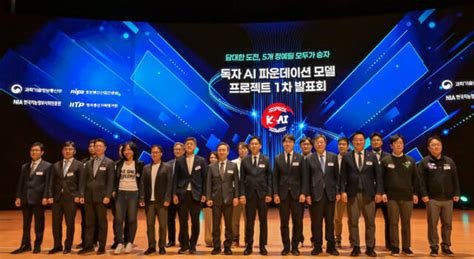
South Korea’s national AI model competition eliminated Naver Cloud and NC AI in the first evaluation round, citing deficiencies in independent technology and ethical‑safety verification. The decision reshapes the selection process, emphasizing transparency, Korean‑specific data, and compliance with new evaluation criteria. The move follows controversy over the “From Scratch” claim that the Naver model was fully home‑grown, prompting the Ministry of Science and ICT to tighten assessment standards.
Project Structure and Current Status
National AI Initiative Overview
The “National Representative AI” program launched in August 2025, selecting five consortia to develop a home‑grown foundation model that reduces reliance on U.S. and Chinese technologies. The government aims to embed Korean language, culture, and data into the AI ecosystem while ensuring cost efficiency and ethical safeguards.
Competitive Timeline
The initiative adopts a “competitive compression” format: the five teams compete for roughly two and a half years, with performance and technical checks guiding the reduction to two final teams by the end of the year.
First‑Round Elimination: “From Scratch” Controversy and Revised Criteria
Initially, only performance scores would determine advancement. Naver Cloud claimed its model was built “From Scratch,” meaning entirely independent of foreign open‑source code. Industry experts questioned the claim, pointing to possible use of external algorithms and a lack of transparency.
In response, the Ministry of Science and ICT announced additional evaluation dimensions, including “technological independence” and “ethical‑safety verification.” Naver Cloud and NC AI fell short on these new criteria, resulting in their first‑round exit.
Remaining Consortia and Their Strengths
- LG AI Research – Highlights large‑scale language model (LLM) development with Korean‑specific fine‑tuning and a reported 30% reduction in energy consumption, underscoring cost efficiency.
- Upstage – Focuses on multimodal learning and an AI ethics framework, offering ready‑to‑deploy enterprise solutions.
- SK Telecom – Leverages telecom and network data for smart‑city and digital‑healthcare applications, showcasing a super‑large model optimized for real‑time services.
All three teams align with the government’s three‑pillar criteria: cost effectiveness, ethical compliance, and cultural/linguistic optimization.
Future Outlook: Implications for the Domestic AI Ecosystem and Policy
Regulatory Strengthening
The controversy may lead the government to mandate disclosure of data sources and algorithmic provenance, establishing a formal AI ethics verification regime.
Industry‑Academia Collaboration
Creating shared validation platforms between universities, research institutes, and corporations will be essential to resolve “From Scratch” disputes and standardize independent training pipelines.
Global Competitiveness
Achieving a truly Korean foundation model requires massive data acquisition and cost‑effective cloud infrastructure. Success could reposition South Korea from a technology follower to a strategic leader with independent AI capabilities by 2027.
Conclusion: Opportunities Behind the Upset
The simultaneous removal of Naver Cloud and NC AI signals a shift toward greater transparency, fairness, and ethical responsibility in AI development. If the remaining three consortia continue to differentiate their models, South Korea could present a nationally representative AI on the world stage by 2027, demonstrating that technical excellence must be paired with trustworthy verification processes.