
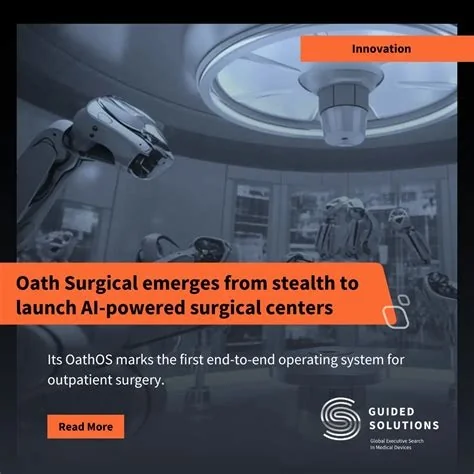
Oath Surgical has teamed with NVIDIA to embed the chip‑maker’s spatial‑AI infrastructure into its OathOS platform, creating AI‑native operating rooms that analyze video, audio, and sensor data in real time. The collaboration aims to deliver multimodal clinical intelligence across the entire surgical workflow, from patient referral through post‑operative recovery, enhancing outcomes and efficiency.
Partnership Overview: AI‑Native Operating Rooms
The alliance integrates NVIDIA’s advanced spatial‑AI stack with OathOS, enabling continuous ingestion of high‑definition video, audio, and sensor streams. This foundation supports real‑time decision support, automated documentation, and proactive anomaly detection throughout each procedure.
AI Stack Integration
By leveraging NVIDIA’s hardware and software, OathOS can process multimodal data at the edge, generating actionable insights without latency. Surgeons receive instant feedback on instrument handling, tissue identification, and procedural milestones.
Future Development Phases
Initial efforts focus on building a robust data pipeline. Subsequent phases will train longitudinal models that evaluate surgeon performance, patient outcomes, and facility efficiency, creating a feedback loop for continuous improvement.
OathOS Platform and Clinical Impact
OathOS serves as an end‑to‑end operating system for outpatient surgery, unifying data capture, clinical decision support, and post‑operative follow‑up within a single digital environment.
Real‑Time Multimodal Data Processing
The platform synchronizes video, audio, and sensor inputs to identify patterns and flag deviations as they occur. This ambient intelligence reduces reliance on manual charting and accelerates critical interventions.
Value‑Based Care and Efficiency Gains
Embedding AI at the point of care aligns with value‑based care models, where outcomes and cost efficiency are measured together. Automated analytics free surgical teams from repetitive tasks, allowing more focus on patient‑centered care.
Market Implications for Outpatient Surgery
AI‑native operating rooms set a new benchmark for ambulatory surgical centers, many of which still depend on legacy electronic health record integrations and manual workflows.
Data Pipeline Control
Owning both the physical facilities and the digital platform gives Oath Surgical full control over the data pipeline, a prerequisite for reliable AI training and deployment.
Potential Reimbursement Shifts
Comprehensive performance data can inform novel reimbursement structures tied to surgeon and facility outcomes, supporting emerging payment models that reward efficiency and quality.
Next Steps and Timeline
The immediate focus is on multimodal data ingestion and real‑time decision support at Oath’s Oregon sites. Training of longitudinal models will follow, with broader rollout anticipated within the next 12‑18 months.
Conclusion
The Oath Surgical–NVIDIA collaboration transforms outpatient surgery by converting intra‑operative data into actionable intelligence. By marrying cutting‑edge spatial AI with a full‑stack surgical platform, the partnership aims to improve patient outcomes, lower costs, and redefine how surgical care is delivered across the United States.


