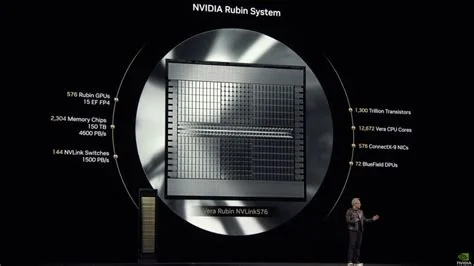
Nvidia unveiled the Rubin platform, a rack‑scale AI supercomputer that combines a high‑performance GPU, a purpose‑built CPU, and ultra‑fast interconnects. The launch sparked immediate attention from Elon Musk, who described the chips as a “rocket engine for AI,” highlighting their potential to accelerate next‑generation artificial‑intelligence workloads. Analysts expect it could reshape data‑center design for large language models.
What Is the Rubin Platform?
Key Components of Rubin
- High‑Performance GPU delivering roughly 50 petaflops of NVFP4 inference, powered by a third‑generation Transformer Engine.
- Vera CPU optimized for reasoning workloads and AI data movement, rather than general‑purpose compute.
- Dedicated GPU‑to‑GPU Interconnect Chip enabling low‑latency data exchange across multiple GPUs.
- Networking and Data‑Processing Chip that handles massive data flows typical of large language models.
- Spectrum‑6 Ethernet Switch providing high‑throughput, low‑latency networking for the entire rack.
Elon Musk’s Endorsement
Elon Musk quickly praised the Rubin chips on X, calling them a “rocket engine for AI.” His endorsement signals strong confidence in the platform’s ability to become a critical piece of infrastructure for companies building advanced AI systems.
Nvidia’s AI Leadership
For years Nvidia has set the standard for AI hardware with its GPUs. Rubin marks the company’s first major hardware family built specifically for the post‑transformer era, moving beyond a GPU‑centric model to a heterogeneous architecture that blends CPUs, specialized interconnects, and networking to reduce data‑movement bottlenecks.
Market and Industry Implications
The integrated nature of Rubin could simplify system design for AI developers. By offering a single‑vendor solution that combines compute, memory movement, and networking, it may lower total‑cost‑of‑ownership and accelerate time‑to‑market for large‑scale models. The platform’s pricing and availability remain undisclosed, prompting investors to watch upcoming Nvidia earnings for further details.
Future Outlook
Nvidia positions Rubin as the foundation for the next generation of AI, though benchmark results and mass‑production roadmaps have yet to be released. As the industry pushes toward specialized AI accelerators, Rubin’s architecture could become a reference point for measuring performance and efficiency in future AI infrastructure.