
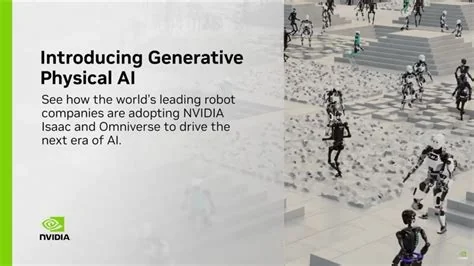
Nvidia has introduced a new “Physical AI” strategy built around the Alpamayo suite, a collection of open‑source models designed to accelerate Level‑4 autonomous driving. The toolkit provides end‑to‑end resources—including model weights, training pipelines, and reference implementations—to help vehicle manufacturers and mobility providers develop self‑driving systems faster and more cost‑effectively.
What Is the Alpamayo Suite?
The Alpamayo suite is a family of AI models focused on perception, planning, and actuation for autonomous vehicles. It delivers a complete development stack that enables developers to train, test, and deploy Level‑4 self‑driving capabilities without building the underlying infrastructure from scratch.
Key Features
- Open‑source licensing for unrestricted use and modification.
- Integrated training pipelines that streamline data ingestion and model optimization.
- Reference implementations for common autonomous‑driving tasks such as object detection and trajectory planning.
Open‑Source Strategy
Nvidia’s open‑source approach aims to foster collaboration across the automotive ecosystem. By providing all necessary components—model weights, code, and documentation—developers can contribute improvements back to the community, driving faster innovation cycles and reducing reliance on proprietary stacks.
Physical AI Explained
Physical AI refers to intelligent systems that directly interact with the real world, including robots, drones, and autonomous vehicles. Nvidia integrates its OpenUSD workflow tools to create high‑fidelity digital twins and synthetic data, enabling extensive simulation before real‑world deployment.
Hardware Foundations
The Alpamayo suite runs on Nvidia’s latest AI hardware, including the GH200 Grace‑Hopper GPUs and the Blackwell architecture. Nvidia employs a three‑computer acceleration strategy that separates workloads for training, inference, and simulation, optimizing performance across specialized platforms.
Industry Impact
Adoption of Alpamayo could shorten development timelines and lower costs for automakers seeking Level‑4 capabilities. The open‑source model lowers barriers for smaller OEMs and startups, while the advanced simulation tools promote extensive virtual testing, potentially becoming a new industry standard.
Safety and Regulatory Considerations
While Alpamayo provides safety‑validation guidelines, compliance with standards such as ISO 26262 remains the responsibility of each vehicle manufacturer. Nvidia’s documentation supports safety verification, but certification must be performed by the OEMs.
Future Outlook
Nvidia’s Physical AI roadmap positions the company as a central AI layer for autonomous vehicles and other embodied AI systems. By combining open‑source software, cutting‑edge hardware, and robust simulation workflows, Nvidia aims to create a collaborative ecosystem that outpaces closed, proprietary solutions.


