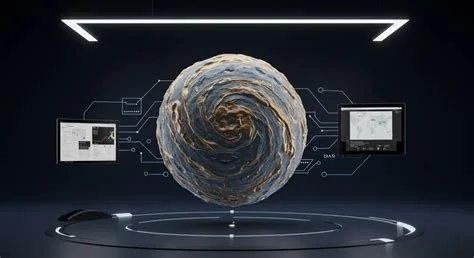
Marble AI’s new World API lets developers generate fully navigable 3D environments from simple text, image, or video prompts. The RESTful service processes multimodal inputs, creates a persistent world model, and returns assets ready for WebGL, Unity, Unreal or VR integration, enabling rapid prototyping of immersive experiences. It also supports real‑time streaming for interactive applications.
How the World API Works
The API accepts asynchronous requests containing multimodal prompts. Upon receiving a request, Marble AI’s proprietary world model—built on neural radiance fields, diffusion techniques, and multimodal fusion—infers geometry, materials, and lighting. When generation completes, the service returns a unique world identifier and downloadable assets in WebGL‑compatible formats as well as standard 3D containers such as glTF and USD.
Developer‑Focused Integration
Designed for easy adoption, the World API provides standard REST endpoints and is accompanied by SDKs for popular programming languages. Generated worlds can be imported directly into Unity or Unreal, streamed into robotics simulators, or embedded on web pages via an iframe. Built‑in API key management, usage monitoring, and billing simplify operational overhead.
Key Benefits for Creators
- Speed: Transform 2D assets into immersive 3D scenes in minutes instead of weeks.
- Flexibility: Supports text, single‑image, panoramic, and video inputs for diverse content sources.
- Compatibility: Outputs ready for web, VR headsets, and major game engines.
- Scalability: Cloud‑based generation handles multiple concurrent requests.
Practical Use Cases
- Game Development: Convert concept art or gameplay footage into playable levels instantly.
- Virtual Reality: Generate personalized immersive tours from user‑provided photos or videos.
- Robotics Simulation: Build realistic training arenas for autonomous agents using real‑world recordings.
- E‑commerce & Architecture: Turn product images or floor plans into interactive 3D showrooms.
Future Outlook
While pricing and performance benchmarks are forthcoming, the public release signals a shift toward a SaaS model for spatial AI. Ongoing developer feedback is expected to drive enhancements such as higher‑resolution outputs, expanded material libraries, and tighter integration with existing 3D authoring tools.
Conclusion
Marble AI’s World API democratizes the creation of explorable 3D environments by exposing a powerful multimodal world model through a developer‑friendly interface. This capability opens new possibilities for game studios, VR creators, simulation engineers, and any team seeking to accelerate spatial content production.