
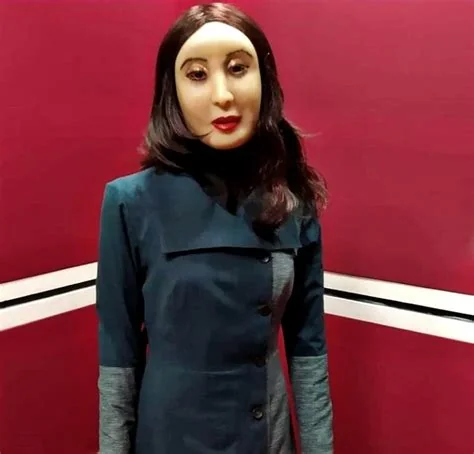
EM O is a humanoid robot that can synchronize its mouth movements with spoken audio and singing across multiple languages in real time, delivering a level of realism that moves beyond the traditional uncanny valley. By learning directly from visual feedback and large‑scale video data, the robot generates natural lip‑sync without hand‑crafted programming.
How EM O Learns to Talk
EM O’s face is constructed from silicone and driven by 26 actuators, each offering up to ten degrees of freedom. Instead of pre‑defining motor positions, the team implemented a vision‑to‑action language model (VLA) that converts visual input into coordinated motor commands.
Self‑Observation and Mirror Training
The robot spent hours in front of a mirror, producing random facial expressions while recording how each actuator moved the silicone lips. This self‑observation created a baseline mapping between motor actions and visual outcomes.
Learning from Online Video Clips
EM O was then exposed to a curated library of video clips featuring humans speaking and singing in ten languages. By correlating its own facial movements with the accompanying audio, the VLA built a direct association between phonemes and the precise actuator configurations needed to reproduce them.
Demonstrating Realistic Lip‑Sync
In live demonstrations, EM O delivers spoken passages and sung phrases, matching mouth shapes to audio with striking fidelity. The robot’s lips open, close, and form shapes that feel genuinely human, eliminating the eerie disconnect typical of earlier prototypes.
Performance testing across the ten languages showed near‑perfect alignment for most phonemes, with an average timing error of less than 30 ms between audio onset and corresponding lip movement—comparable to natural human speech production.
Why Real‑Time Lip‑Sync Matters
Achieving natural lip‑sync addresses the core challenge of the uncanny valley, where almost‑human robots provoke discomfort due to mismatched facial dynamics. The breakthrough opens new possibilities in several domains:
- Human‑Robot Interaction: More natural facial expressions can boost trust and engagement in service robots, telepresence avatars, and assistive devices.
- Entertainment & Media: Real‑time lip‑sync enables on‑stage robotic performers and interactive virtual characters.
- Language Learning & Accessibility: Accurate visual speech cues can serve as pronunciation guides for learners and visual aids for the hearing impaired.
Limitations and Future Directions
Current challenges include handling rapid, high‑frequency consonants and extreme mouth shapes required for certain phonemes. Expanding the training dataset and refining the VLA architecture are planned next steps.
Additionally, EM O’s facial hardware remains a silicone prototype. Transitioning to durable, production‑grade materials will be essential for commercial deployment. Future work also aims to integrate emotional expression, pairing lip‑sync with appropriate facial affect while avoiding a return to the uncanny valley.
Broader Impact on Robotics
EM O exemplifies a shift from rule‑based animation to data‑driven motor control, demonstrating that AI systems can learn physical behaviors directly from visual data. This approach can accelerate the development of lifelike machines across industries, from gesture generation to full‑body motion synthesis.
Conclusion
EM O’s realistic, real‑time lip‑sync marks a measurable step toward robots that communicate naturally with humans. As the technology matures, it may redefine expectations for human‑robot interaction, bringing us closer to machines that not only speak but truly are heard.


