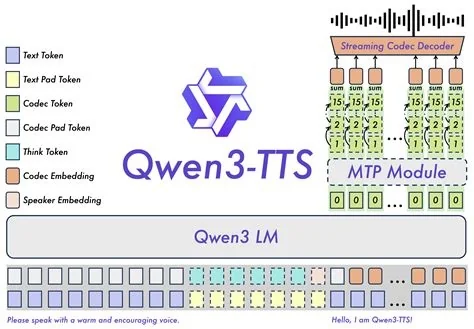
Qwen3‑TTS is an open‑source text‑to‑speech system from Alibaba Cloud that delivers stable, expressive, and streaming speech synthesis in ten major languages. The 1.7 billion‑parameter model supports free‑form voice design, rapid voice cloning from as little as three seconds of audio, and fine‑grained control over tone, rate, and emotion, all while running in real time on consumer‑grade hardware.
Key Features of Qwen3‑TTS
Multilingual Support
Qwen3‑TTS covers Chinese, English, Japanese, Korean, German, French, Russian, Portuguese, Spanish, and Italian, with multiple dialectal voice profiles for each language.
Voice Design & Cloning
- Voice Design: Create new voices using natural‑language descriptions such as “a warm, youthful female voice with a slight British accent.”
- Voice Clone (Base): Replicate a target speaker’s timbre from as little as three seconds of reference audio, matching the quality of many commercial services.
- CustomVoice TTS: Combine predefined speaker profiles with style instructions for precise output control.
Real‑Time Streaming Performance
The model operates at a 12 Hz frame rate, enabling low‑latency streaming synthesis that fits on standard consumer GPUs and CPUs.
Technical Architecture
Transformer Backbone & Prosody Control
Built on Alibaba’s Qwen transformer architecture, Qwen3‑TTS incorporates phoneme‑level conditioning and prosody embeddings, allowing detailed manipulation of pitch, rhythm, and emotional expression.
Model Size & Efficiency
The base version contains 1.7 billion parameters, striking a balance between high‑quality output and manageable resource requirements. Training leveraged over 5 million hours of speech data to ensure robust contextual understanding.
Benefits for Developers and Industries
Cost‑Effective Open‑Source Solution
Released under the Apache 2.0 license, Qwen3‑TTS can be freely used, modified, and commercialized, eliminating the need for expensive proprietary API subscriptions.
Applications in Gaming, E‑Learning, and Virtual Assistants
- Generate custom character voices on‑the‑fly for immersive game experiences.
- Produce multilingual narration for e‑learning modules without hiring multiple voice actors.
- Enable dynamic, localized speech output in virtual assistants and chatbots.
Future Outlook
Alibaba Cloud plans larger model variants and expanded dialect coverage, aiming to push voice realism and further reduce latency. Developers can start experimenting now by cloning the repository, loading the pre‑trained checkpoints, and deploying via Docker or integrated visual programming interfaces.