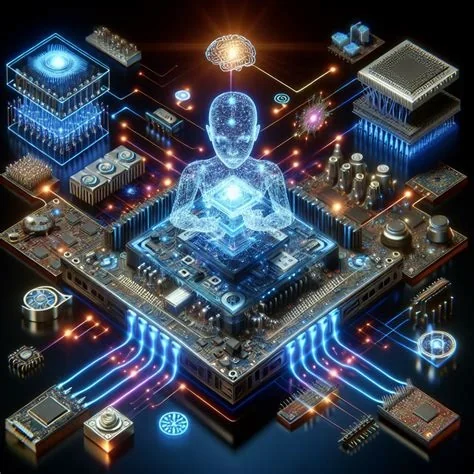
Role in AI Systems
AI hardware plays a crucial role in managing the computational overhead of AI models, especially in real-time, in-house, in the cloud, and in edge computing environments.
Recent Developments in AI Hardware
Recent developments in AI hardware include specialized accelerators like Google’s Tensor Processing Units (TPUs) and AMD’s Instinct MI300 series, optimized for deep learning in real-time, in-house, in the cloud, and in edge computing environments.
Practitioners Perspective
Optimizing hardware for AI in real-time in-house, in the cloud, in edge computing, requires robust, energy-efficient, and scalable computing, marking a new dawn in hardware’s impact on AI’s performance, efficiency, and scalability in real-time, in-house, in the cloud, in edge computing environments.
Implications in the Tech Landscape
The impact of AI hardware in the tech landscape is significant, marking a shift in hardware’s role in AI systems, in real-time, in-house, in the cloud, in edge computing, marking a new era in hardware’s impact on AI’s performance, efficiency, and scalability in real-time, in-house, in the cloud, in edge computing environments.
Conclusion
Optimizing hardware for AI in real-time in-house, in the cloud, in edge computing, requires robust, energy-efficient, and scalable computing, marking a new dawn in hardware’s impact on AI’s performance, efficiency, and scalability in real-time, in-house, in the cloud, in edge computing environments.
Sources
- IBM, “Think”
- Wikipedia, “Hardware for artificial intelligence”
- IBM Research, “AI Hardware”
- Medium, “The Complete Guide to Computer Hardware for AI”