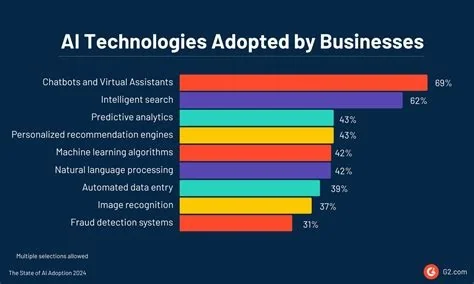
A recent cross‑industry survey reveals that 78 % of U.S. companies now run AI in at least one department, and 40 % of employees rely on generative AI tools every day. Those figures show AI has moved from experimental projects to everyday operations, delivering measurable productivity boosts and reshaping how you work.
Why AI Is Becoming a Core Business Function
Businesses aren’t treating AI as a novelty any longer; it’s a baseline capability that drives cost savings and faster decision‑making. Companies that integrate AI into demand forecasting, inventory management, or customer insights often see double‑digit efficiency gains. If you’re still on the fence, the data suggests you’ll miss out on a competitive edge.
Industry Highlights
- Legal sector: More than half of large U.S. law firms have embedded AI into document review and research workflows.
- Healthcare: AI tools now support clinical and back‑office operations in the majority of hospitals.
- Retail: AI‑driven demand‑forecasting systems have cut inventory waste by around 18 %.
Employee Productivity Gains
Workers who use generative AI report strong productivity improvements. About 95 % say AI has a positive impact, and 72 % notice high gains in speed and accuracy. Complex tasks—coding, data analysis, content creation—can be completed up to 66 % faster, letting you focus on higher‑value work.
Real‑World Impact
- A marketing agency nearly doubled its client load after AI handled copywriting and reporting.
- Senior legal partners reduced contract review time from days to hours, enabling a 30 % increase in case volume.
- Retail analysts cut report‑drafting time by half, freeing staff for strategic planning.
Economic Outlook and Energy Considerations
The AI market is projected to keep expanding, with the United States capturing a large share of global growth. While training large models consumes significant power—roughly 50 GWh per model—most businesses rely on free or low‑cost AI versions, keeping entry barriers low. The productivity upside often outweighs the energy costs, especially as you scale AI usage.
Future Outlook and Strategic Implications
If adoption rates stay steady, AI could be embedded in virtually every business process within the next few years. However, rapid capital inflows may outpace sustainable revenue for early‑stage startups, so you’ll want to prioritize proven solutions. Policymakers are already shaping AI ethics frameworks, which will influence how you implement and govern these technologies.
Bottom line: AI is no longer a buzzword; it’s a functional layer that 78 % of American firms can’t afford to ignore. Embracing it now positions you for lasting productivity gains and a stronger market stance.