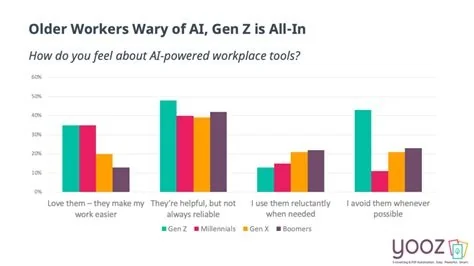
Gallup’s latest workplace survey shows that AI tools are now used by roughly 46 percent of U.S. employees, indicating a plateau in overall adoption. While the broad adoption rate has steadied, daily or near‑daily AI usage continues to rise sharply among senior leaders and knowledge‑intensive roles, highlighting a growing divide between occasional adopters and power users.
Survey Overview and Key Findings
The Gallup poll asked a nationally representative sample of American workers how often they engage with AI at work. Respondents who use AI at least a few times a year represent the 46 percent adoption figure, a flat line after rapid growth in previous years. The survey also measured “frequent use,” defined as daily or near‑daily interaction with AI tools.
Adoption Rate Holds Steady
Overall AI adoption has leveled off, suggesting that the early‑adopter wave—driven by curiosity, pilot projects, and low‑cost services—has reached saturation among the broader workforce. Employees who have not yet incorporated AI may encounter structural or skill‑based barriers that limit further expansion.
Frequent Use Grows Among Leaders
Despite the plateau, frequent AI use is climbing, especially among executives, managers, and professionals whose jobs rely heavily on data analysis, content creation, or strategic planning. These power users are shifting from occasional experimentation to routine reliance on AI for tasks such as market analysis, report generation, and scenario modeling.
Who Uses AI Most Often
Frequent AI usage is concentrated in knowledge‑based roles. Senior decision‑makers leverage AI for forecasting and strategic insight, while engineers, marketers, analysts, and developers turn to AI for code assistance, content drafting, and data visualization. Industries with high information‑processing demands—technology, finance, consulting, and media—are likely driving this uptick.
Business Implications
- Closing the usage gap: Organizations should provide targeted training and change‑management resources to employees with only sporadic AI exposure, ensuring productivity gains are distributed more evenly.
- Accelerated decision‑making: Leaders who routinely use AI set new expectations for speed and data‑driven insight, potentially redefining performance benchmarks across teams.
- Shift to AI‑orchestrated workflows: Future growth may come from deeper integration, where advanced models coordinate multiple tools, creating opportunities for specialized AI platforms that act as intermediaries.
Future Outlook for AI Integration
The survey highlights a “frequency paradox”: depth of AI use is outpacing breadth. As organizations strive to scale high‑impact, frequent usage across more roles, AI is transitioning from a novelty to an operational cornerstone. Stakeholders—from HR leaders to technology vendors—must monitor these trends to guide training, workflow redesign, and investment in AI‑orchestrating solutions that can sustain the next phase of workplace transformation.