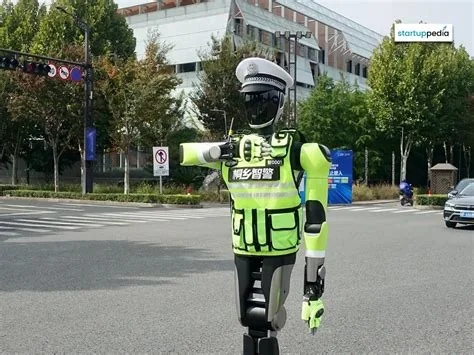
China’s public‑security forces have begun deploying the Intelligent Police Unit R001, an AI‑driven humanoid robot marketed as “RoboCop,” to manage traffic and enforce minor violations in major cities. The units operate 24/7, issue warnings and tickets, and work alongside human officers to improve road safety and streamline enforcement while reducing officer overtime.
What Is the Intelligent Police Unit R001?
The R001 is a life‑sized humanoid robot built by AiMOGA Robotics, a subsidiary of Chery. Designed as a mobile traffic‑monitoring assistant, it combines advanced perception technology with a police‑style uniform to interact directly with motorists and pedestrians. The robot does not carry weapons; instead, it relies on high‑definition cameras, infrared sensors, and acoustic modules to detect infractions and communicate corrective actions.
Key Features and Capabilities
- Multimodal perception system that detects traffic violations in real time.
- High‑definition cameras and infrared sensors for 24/7 monitoring.
- Audible warnings and on‑site ticket issuance.
- Wheeled base for precise navigation and hand‑signal guidance.
- Weather‑resistant design that operates continuously without fatigue.
Current Deployments in Major Chinese Cities
The R001 units have been rolled out in several municipalities, where they are integrated with existing traffic‑management infrastructure. Each deployment pairs the humanoid robots with quadruped and wheeled platforms to create a layered enforcement network that covers high‑traffic zones and supports human officers during peak periods.
City‑by‑City Overview
- Chengdu – R001 units manage busy intersections, coordinate with other robotic assistants, and provide real‑time traffic flow data.
- Hangzhou – Robots enforce parking regulations, direct cyclists to designated lanes, and issue on‑site citations.
- Wuhu – Units operate alongside human traffic officers, offering round‑the‑clock supervision and immediate response to violations.
Impact on Traffic Management and Public Safety
Early observations indicate that the AI‑powered robots improve compliance with traffic rules by delivering consistent, unbiased warnings. Their ability to record violations for later review enhances accountability, while the continuous presence of R001 units deters illegal parking and red‑light running. Although official statistics are pending, the technology promises to reduce minor accidents and free human officers for more complex duties.
Benefits for Law Enforcement
- Continuous coverage without fatigue or overtime constraints.
- Standardized enforcement through uniform warnings and signals.
- Reduced workload for human officers, allowing focus on high‑risk incidents.
- Data collection for traffic analysis and policy planning.
Future Outlook for AI‑Assisted Policing
China’s authorities view the R001 rollout as a pilot for broader AI‑enabled public safety initiatives. Plans include expanding the robot fleet to additional cities, integrating more advanced decision‑making algorithms, and exploring non‑security applications such as healthcare assistance and public event support. Successful deployment could set a benchmark for municipalities worldwide seeking to blend artificial intelligence with everyday civic services.