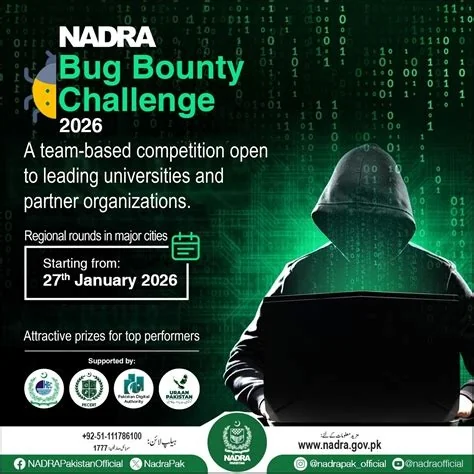
Pakistan’s National Database and Registration Authority launched its first Bug Bounty Challenge, opening its digital identity systems to scrutiny from ethical hackers and security researchers. The move represents a significant shift for a government agency handling some of the country’s most sensitive data.
What NADRA Is Putting on the Table
The program targets NADRA’s public-facing applications, APIs, and the Centralized Database Management System that underpins Pakistan’s national ID infrastructure. Researchers can probe for authentication bypasses, injection attacks, cloud-service misconfigurations, and other vulnerabilities that could compromise citizen data.
Participants who find and responsibly disclose valid vulnerabilities receive cash rewards, public recognition, and direct engagement with NADRA’s internal security team. The agency positioned this as both a security hardening measure and a way to identify and nurture local cybersecurity talent.
Why This Matters
NADRA handles biometric data, national ID cards, and verification services used across Pakistan’s banking, telecom, and government sectors. A breach at NADRA wouldn’t just expose personal information—it could undermine the trust infrastructure that multiple industries depend on for identity verification.
Bug bounty programs have become standard practice for tech companies, but government agencies—especially those managing national identity systems—have been slower to adopt them. NADRA joining this approach signals recognition that closed security models can’t keep pace with modern threats.
Who Can Participate
The challenge is open to ethical hackers, university students, and security professionals. NADRA specifically mentioned interest in engaging Pakistan’s emerging cybersecurity community, suggesting the program serves dual purposes: finding vulnerabilities and building relationships with local talent.
Participants must follow responsible disclosure protocols—findings go to NADRA’s security team rather than public channels. The rules likely include standard bug bounty exclusions around denial-of-service testing and social engineering.
Broader Implications
If NADRA’s bug bounty produces meaningful results, it could encourage other Pakistani government agencies to adopt similar programs. The country’s digital transformation efforts have accelerated recently, and the attack surface has expanded accordingly.
For the security research community, NADRA’s program adds a notable target in South Asia. Government bug bounties in the region remain relatively rare, and participation in programs like this can establish credentials for researchers building their careers.
What Happens Next
The success of the program depends on execution—fair evaluation of submissions, timely payouts, and genuine remediation of discovered vulnerabilities. Bug bounties work when organizations treat researchers as partners rather than adversaries. NADRA’s willingness to open its systems to external testing suggests the right intent; the follow-through will determine whether researchers engage seriously with the program.