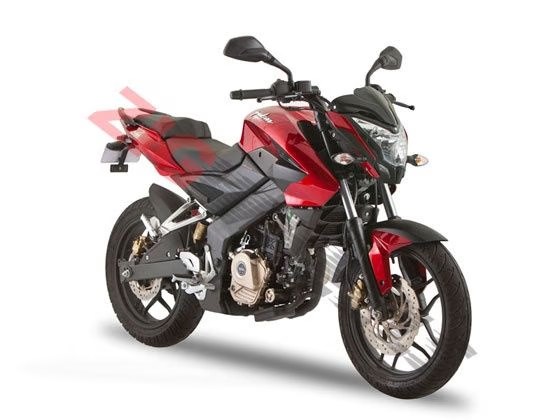
Bajaj Auto, the Indian two‑wheeler giant that turned the country’s streets into a pulsating arena of sport‑bike culture with the launch of the Pulsar Classic in 2001, is poised for a dual‑front resurgence in 2026. The company is reportedly preparing a modern reinterpretation of the iconic Pulsar Classic, while its exclusive Bangladeshi partner, Uttara Motors Ltd., has just opened a dedicated “Pulsar Studio” experience centre in Dhaka and rolled out the premium Pulsar N‑series models N250 and N160. At the same time, Nvidia has announced a completely unrelated but similarly named “Pulsar” technology—a G‑Sync module that promises 1000 Hz motion clarity for 360 Hz gaming monitors—adding a high‑tech twist to the month’s “pulsar” headlines.
A Classic Reborn for 2026
Since its debut, the Pulsar Classic has been more than a motorcycle; it became a cultural touchstone for a generation of Indian riders seeking performance, style, and affordability. The bike’s 150 cc and 180 cc variants dominated the entry‑level sport segment for more than a decade, eventually giving way to newer models such as the Pulsar NS160 and the RS200.
Industry analysts cite a growing nostalgia among younger riders and a renewed appetite for retro‑styled machines as the catalyst for Bajaj’s contemplated revival. Sources close to the company say the new Classic will retain its signature teardrop fuel tank and single‑sided swingarm while integrating contemporary features: a fuel‑injected, Euro‑5 compliant engine, ride‑by‑wire throttle, LED lighting, and a digital instrument cluster with Bluetooth connectivity.
If launched as rumored, the reborn Classic could bridge the gap between heritage and technology, offering a compelling alternative to imported retro bikes that command premium prices. “We want to give Indian riders a bike that respects the past but speaks the language of today’s tech‑savvy consumer,” said a Bajaj spokesperson who preferred to remain off‑record pending official confirmation.
Uttara Motors’ Pulsar Studio and N‑Series Launch
Across the border in Bangladesh, Bajaj’s sole distributor, Uttara Motors Ltd., has taken a bold step to cement its dominance in the sports‑bike segment. On January 9, 2026, the company inaugurated the “Pulsar Studio” at its Uttara Centre on Eskaton Road, Dhaka. The purpose‑built showroom is more than a retail space; it offers immersive test‑ride simulations, a customization lounge, and a museum‑style exhibit that traces the evolution of the Pulsar line from its 2001 inception to the present day.
The studio’s launch coincided with the unveiling of two new models: the Pulsar N250 and N160. Both bikes sit at the top of Bajaj’s N‑series hierarchy, targeting riders who demand higher performance without crossing into the premium price bracket of the RS200. The N250 is powered by a 250 cc, single‑cylinder, fuel‑injected engine delivering 27 hp and a claimed 0‑60 km/h sprint in 3.8 seconds, while the N160 carries forward the proven 160 cc platform with updated ergonomics and a refined chassis. Prices are positioned competitively at BDT 1.75 lakh for the N250 and BDT 1.45 lakh for the N160, roughly equivalent to INR 1.4 lakh and INR 1.2 lakh respectively.
Uttara Motors’ Managing Director, Mr. Shahidul Islam, emphasized that the studio is designed to “create an experiential ecosystem where enthusiasts can feel the heritage, test the technology, and personalize their ride.” The move aligns with a broader trend in emerging markets where manufacturers and distributors are shifting from pure sales to lifestyle‑focused brand experiences.
Implications for the South Asian Two‑Wheeler Market
The simultaneous revival of the Pulsar Classic in India and the launch of the N‑series in Bangladesh signal Bajaj’s aggressive push to consolidate its market share across South Asia. According to a recent report by the Society of Indian Automobile Manufacturers (SIAM), the sports‑bike segment is projected to grow at a CAGR of 7 % between 2026 and 2031, driven by rising disposable incomes and a youthful demographic.
A refreshed Classic could appeal to both nostalgic older riders and younger consumers drawn to retro aesthetics, potentially expanding the market’s age base. Meanwhile, the N250 and N160 give Uttara Motors a fresh product ladder that can capture riders transitioning from entry‑level 150 cc bikes to higher‑displacement machines without the price shock of premium imports.
Competition, however, is intensifying. KTM’s recent launch of the RC 160, priced at INR 1.85 lakh, has sparked a wave of price‑matching alternatives, including Yamaha’s R15M and Bajaj’s own Pulsar NS200. With multiple manufacturers targeting the sub‑₹2 lakh bracket, brand differentiation through technology, after‑sales service, and experiential retail—like Pulsar Studio—will be critical.
Nvidia’s “Pulsar” G‑Sync: A Different Kind of Speed
On the technology front, the term “Pulsar” made headlines at CES 2026, where Nvidia unveiled a new G‑Sync module dubbed “Pulsar.” Unlike the motorbike references, this Pulsar is a hardware solution that pushes motion clarity to 1000 Hz on 360 Hz gaming monitors, effectively eliminating ghosting and reducing input latency for competitive e‑sports.
While unrelated to Bajaj’s two‑wheel ventures, the naming coincidence underscores how the word “pulsar”—originally an astronomical term for rapidly rotating neutron stars—has become a metaphor for high‑performance, rapid response across industries. For gamers, Nvidia’s Pulsar could set a new benchmark, just as Bajaj’s upcoming Classic aims to set a benchmark for retro‑modern motorcycling.
Looking Ahead
Bajaj Auto’s forthcoming Classic and the aggressive rollout of the N‑series in Bangladesh illustrate a strategic blend of heritage and innovation. By coupling product refreshes with immersive retail concepts, the company is positioning itself to dominate the sports‑bike narrative in a region where two‑wheelers remain the primary mode of personal transport.
At the same time, Nvidia’s Pulsar G‑Sync serves as a reminder that “pulsar” now carries connotations of speed and precision far beyond the road. Whether on a winding Indian highway or a high‑refresh‑rate gaming rig, the pursuit of rapid, seamless performance continues to drive both automotive and consumer‑tech markets forward.
As 2026 unfolds, riders and gamers alike will be watching how these distinct “pulsar” initiatives shape their respective landscapes—one revving up engines, the other refreshing frames per second. The convergence of legacy, technology, and experience may well define the next chapter of “pulsar” dominance.
This topic is currently trending in Technology.